
Search Projects
PUBLICATIONS
Our Publications
01
Graphene Quantum-Dot Based Integrated Biosensors for Point-Of-Care Diagnostics of Neonatal Sepsis
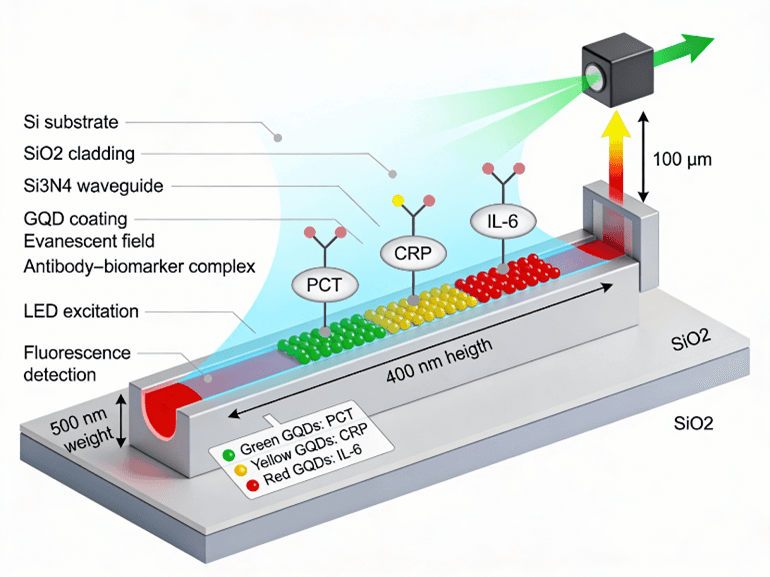
By integrating photonic sensing with fluorescence-based signal modulation, this work enables sensitive, multiplexed biomarker detection from small blood volumes. Quantum-enabled simulations performed on the IBM Quantum runtime were used to model and measure sensor performance using shot-based simulations (2,000 measurements per condition) of biomarker-dependent fluorescence quenching and photonic wavelength shifts at clinically relevant concentrations. These simulations allowed dose-response analysis, estimate of limit-of-detection and comparison with the known neonatal clinical decision thresholds.
Key Point
Integration of GQDs with Silicon Nitride Photonic Waveguides
Biomarker Detection Strategies for Neonatal Sepsis
Dual-Mode Signal Transduction and Thermal Compensation
Clinical Decision Algorithm for Neonatal Triage
Quantum Circuit Implementation and Results
01
Graphene Quantum-Dot Based Integrated Biosensors for Point-Of-Care Diagnostics of Neonatal Sepsis
By integrating photonic sensing with fluorescence-based signal modulation, this work enables sensitive, multiplexed biomarker detection from small blood volumes. Quantum-enabled simulations performed on the IBM Quantum runtime were used to model and measure sensor performance using shot-based simulations (2,000 measurements per condition) of biomarker-dependent fluorescence quenching and photonic wavelength shifts at clinically relevant concentrations. These simulations allowed dose-response analysis, estimate of limit-of-detection and comparison with the known neonatal clinical decision thresholds.
Key Point
Integration of GQDs with Silicon Nitride Photonic Waveguides
Biomarker Detection Strategies for Neonatal Sepsis
Dual-Mode Signal Transduction and Thermal Compensation
Clinical Decision Algorithm for Neonatal Triage
Quantum Circuit Implementation and Results
01
Graphene Quantum-Dot Based Integrated Biosensors for Point-Of-Care Diagnostics of Neonatal Sepsis
By integrating photonic sensing with fluorescence-based signal modulation, this work enables sensitive, multiplexed biomarker detection from small blood volumes. Quantum-enabled simulations performed on the IBM Quantum runtime were used to model and measure sensor performance using shot-based simulations (2,000 measurements per condition) of biomarker-dependent fluorescence quenching and photonic wavelength shifts at clinically relevant concentrations. These simulations allowed dose-response analysis, estimate of limit-of-detection and comparison with the known neonatal clinical decision thresholds.
Key Point
Integration of GQDs with Silicon Nitride Photonic Waveguides
Biomarker Detection Strategies for Neonatal Sepsis
Dual-Mode Signal Transduction and Thermal Compensation
Clinical Decision Algorithm for Neonatal Triage
Quantum Circuit Implementation and Results
02
EmoSign-GH: A multimodal dataset for understanding emotions in Ghanaian Sign Language
Datasets for emotion recognition are typically annotated using either discrete or dimensional emotion frameworks. Discrete emotion labels are based on theories of basic emotion, which suggest that there are a limited number of emotion states (e.g., fear, happiness) associated with distinct expressions and physiological states [14]. In contrast, dimensional approaches quantify emotion along continuous axes, predominantly emotional arousal and valence [11]. Recent advances in large language models (LLMs) have expanded the scope of emotion recognition beyond the traditional paradigm of emotion label prediction. These models facilitate a more generative approach to emotion understanding, producing detailed, comprehensive descriptions of emotional states in natural language [27]. This shift has prompted the development of new datasets and metrics that accommodate rich natural language descriptions of emotions, allowing for greater nuance in emotion analysis.

Key Point
Emotion recognition
Dataset Collection and Pre-processing
AnnotationConstruction
DatasetPost-processing
FinalDatasetAnalysis
02
EmoSign-GH: A multimodal dataset for understanding emotions in Ghanaian Sign Language
Datasets for emotion recognition are typically annotated using either discrete or dimensional emotion frameworks. Discrete emotion labels are based on theories of basic emotion, which suggest that there are a limited number of emotion states (e.g., fear, happiness) associated with distinct expressions and physiological states [14]. In contrast, dimensional approaches quantify emotion along continuous axes, predominantly emotional arousal and valence [11]. Recent advances in large language models (LLMs) have expanded the scope of emotion recognition beyond the traditional paradigm of emotion label prediction. These models facilitate a more generative approach to emotion understanding, producing detailed, comprehensive descriptions of emotional states in natural language [27]. This shift has prompted the development of new datasets and metrics that accommodate rich natural language descriptions of emotions, allowing for greater nuance in emotion analysis.
Key Point
Emotion recognition
Dataset Collection and Pre-processing
AnnotationConstruction
DatasetPost-processing
FinalDatasetAnalysis
02
EmoSign-GH: A multimodal dataset for understanding emotions in Ghanaian Sign Language
Datasets for emotion recognition are typically annotated using either discrete or dimensional emotion frameworks. Discrete emotion labels are based on theories of basic emotion, which suggest that there are a limited number of emotion states (e.g., fear, happiness) associated with distinct expressions and physiological states [14]. In contrast, dimensional approaches quantify emotion along continuous axes, predominantly emotional arousal and valence [11]. Recent advances in large language models (LLMs) have expanded the scope of emotion recognition beyond the traditional paradigm of emotion label prediction. These models facilitate a more generative approach to emotion understanding, producing detailed, comprehensive descriptions of emotional states in natural language [27]. This shift has prompted the development of new datasets and metrics that accommodate rich natural language descriptions of emotions, allowing for greater nuance in emotion analysis.
Key Point
Emotion recognition
Dataset Collection and Pre-processing
AnnotationConstruction
DatasetPost-processing
FinalDatasetAnalysis



Learn about our projects
Whether you’re envisioning a custom home, a commercial space, or a major renovation, our team of experienced professionals is here to guide you every step of the way. With a commitment to quality, innovation, & client satisfaction.