
Service
Graphene Quantum-Dot Based Integrated Biosensors for Point-Of-Care Diagnostics of Neonatal Sepsis
Abstract
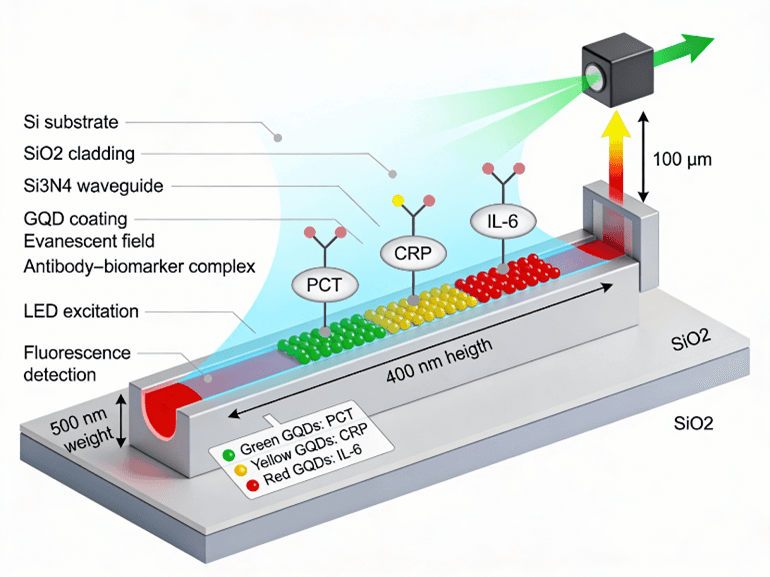
Neonatal sepsis remains a leading cause of infant mortality worldwide, a crisis exacerbated by the 24–72 hour delay of gold-standard blood cultures and the severe lack of diagnostic infrastructure. This work presents a transformative point-of-care (POC) diagnostic system utilizing graphene quantum dot (GQD)-enhanced silicon nitride photonic waveguides for the ultra-rapid, multiplexed detection of procalcitonin (PCT), C-reactive protein (CRP), and interleukin-6 (IL-6).
By integrating photonic sensing with fluorescence-based signal modulation, this work enables sensitive, multiplexed biomarker detection from small blood volumes. Quantum-enabled simulations performed on the IBM Quantum runtime were used to model and measure sensor performance using shot-based simulations (2,000 measurements per condition) of biomarker-dependent fluorescence quenching and photonic wavelength shifts at clinically relevant concentrations. These simulations allowed dose-response analysis, estimate of limit-of-detection and comparison with the known neonatal clinical decision thresholds.
The sensor achieves a 0.02 ng/mL limit of detection for IL-6, enabling life-saving intervention within the critical 1–4hour window of infection onset. The findings suggest that the system is capable of providing actionable diagnostic information within 15 minutes using minimal sample volumes, which justify early rule-in and rule-out decisions in neonatal sepsis. By bridging the gap between laboratory-grade sensitivity and rapid point-of-care testing, this approach offers a scalable solution for improving early neonatal sepsis diagnosis across diverse clinical settings.
More about the publication
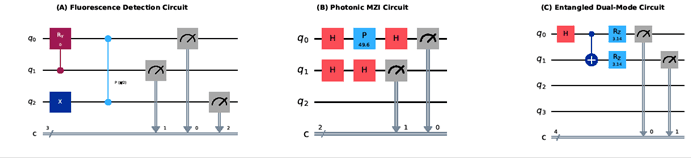
Fluorescence detection circuit encoding the GQD electronic state, photon occupation, and biomarker binding, with resonant excitation and FRET‑induced dephasing operations. (B) Mach–Zehnder interferometer circuit modeling the silicon nitride waveguide with a sensing and reference arm, where biomarker‑induced refractive index changes are represented as phase shifts that modulate the interference pattern. (C) Entangled dual‑mode circuit in which photonic and fluorescence modes are prepared in a Bell state and subjected to matched biomarker‑dependent phase rotations to evaluate quantum‑enhanced cross‑validation between the two readout channels.
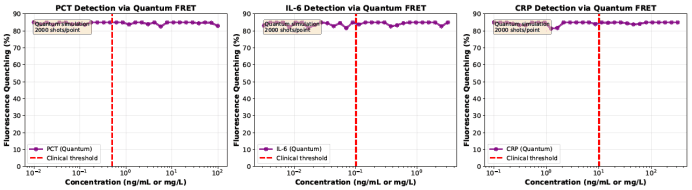
The figure shows quantum‑simulated fluorescence quenching versus biomarker concentration for PCT, IL‑6, and CRP, highlighting steep FRET‑mediated signal changes around neonatal clinical decision thresholds on a logarithmic concentration scale.