AI-Enhanced Quantum Error Correction
This research project sits right at that border, and it is concerned with the application of artificial intelligence to enhance quantum error correction and move quantum hardware to a state where it can be fault tolerant.
RESEARCHER
Elliot Ransford Amponsah
Category
Quantum Computing
Year
2025
The emergence of quantum technologies comes at a time when classical computing is reaching the physical limits of the Moore law, which has been growing exponentially in the past decades as transistors kept being progressively reduced in size on silicon chip boards.
As further miniaturization turns out to be more expensive and less efficient, new paradigms must be sought to further advance computation, particularly in solving complex problems such as modeling complex materials, optimizing large systems, and breaking cryptographic schemes, which are intractable using even the fastest supercomputers of classical types. Based on superposition and entanglement, quantum systems provide a qualitatively different model of computation enabling a relatively small number of qubits in a computation to search a state space of exponentially growing size and, potentially, achieve disruptive speedups in chemistry, materials science, and secure communication. Nonetheless, actual quantum systems are very delicate: noise in the environment, lack of control, and decoherence constantly spoil quantum systems and the error rates are much too high to be able to run large-scale, error-resilient algorithms without expensive quantum error correction.
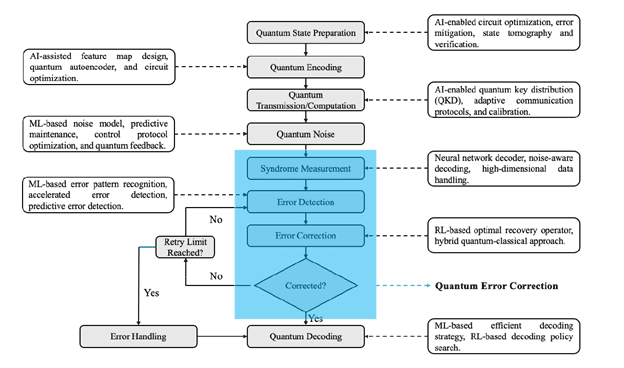
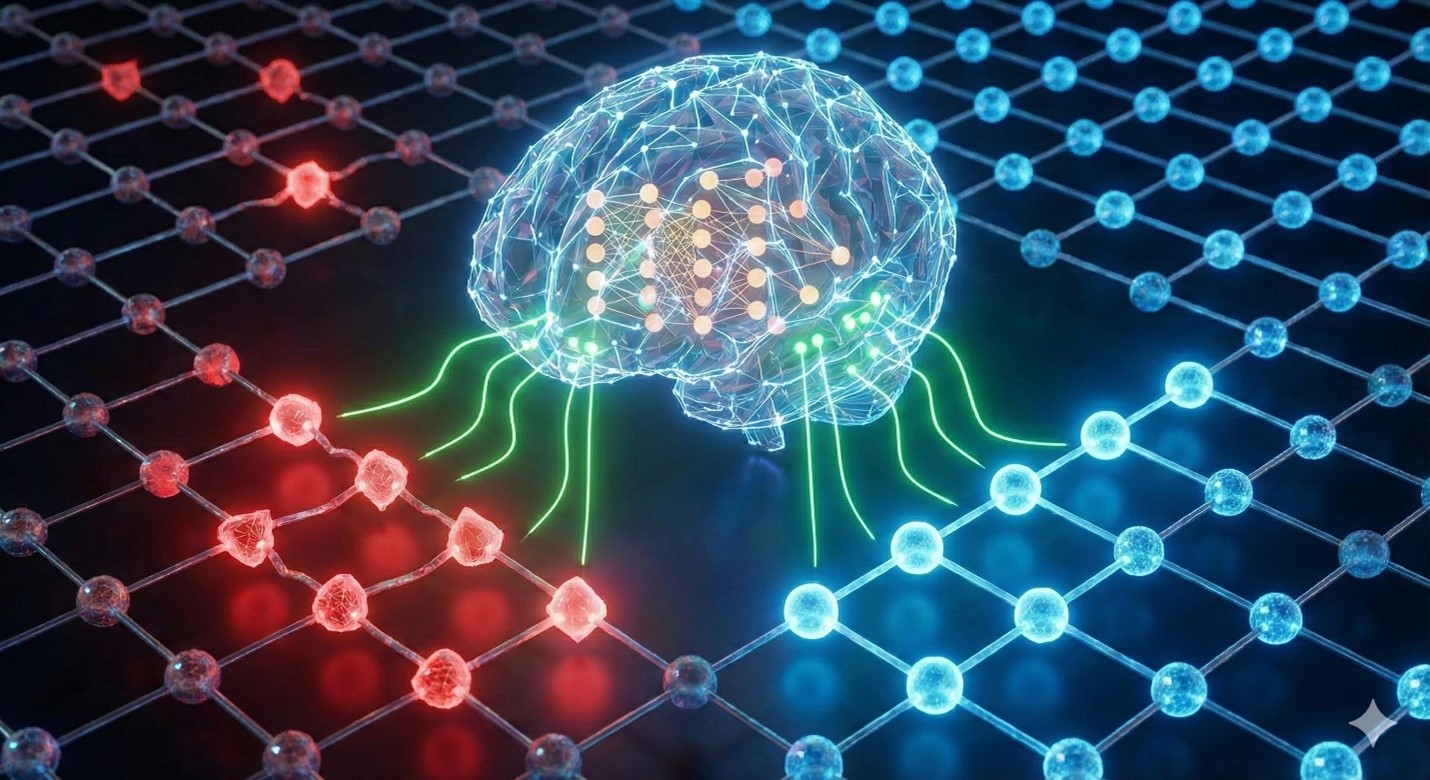
This research project sits right at that border, and it is concerned with the application of artificial intelligence to enhance quantum error correction and move quantum hardware to a state where it can be fault tolerant. Leading code decoders like the surface code are efficient but do not scale as well as they would have with smarter adaptive designs and must operate with ultra-low-latency hardware, which is highly challenging in real devices. With the help of modern machine learning, including convolutional and graph neural networks that discover complex patterns in the syndrome data and reinforcement learning agents that optimize correction plans in the dynamic environment, the lab develops AI-based decoders, and control schemes that are more accurate, noise-sensitive, and hardware-constrained. The work does not only explore the state of the art in AI-enhanced quantum error correction but will also prototype the algorithms that will secure the next-generation quantum processors and transform noisy and fragile qubits into robust computational assets.